

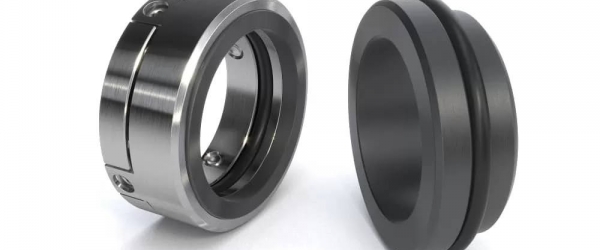
When designing a mechanical seal, the choice of material for the sealing faces is one of the most important technical decisions. Two of the most commonly used materials in this field are carbon and silicon carbide (SiC): both are widely used and reliable, but they have very different characteristics that make them suitable for distinct applications.
Understanding the differences between these two materials is not just a theoretical matter: it means knowing how to choose the right solution based on the fluid to be contained, the operating conditions, and the system’s durability requirements.
In this article, we at Meccanotecnica Umbra will compare carbon and silicon carbide mechanical seals, analyzing the properties, advantages, limitations, and typical applications of each, to help you make a more informed decision.
Carbon is one of the most popular materials for sealing surfaces thanks to a characteristic that clearly sets it apart: self-lubrication. This property allows it to reduce friction and heat even when lubrication is not perfect, making it particularly tolerant during startup or under unstable operating conditions. Compared to other materials, carbon adapts more easily to contact surfaces, ensuring an effective seal even in the presence of minor imperfections or misalignments.
The main limitation concerns wear resistance: in environments with abrasive fluids or under harsh conditions, the carbon tends to wear down more quickly, reducing the overall service life of the seal.
For this reason, carbon seals are ideally suited for standard applications involving clean fluids (water pumps, household appliances, automotive systems) where operating conditions are controlled and lubrication is adequately provided by the fluid itself.
Silicon carbide is a synthetic ceramic material known for its high hardness and exceptional wear resistance. These characteristics make it the natural choice when operating conditions become demanding: abrasive fluids such as dirty water, sludge, or slurry; high pressures; high speeds; or high temperatures.
Unlike carbon, silicon carbide is not self-lubricating: it performs best when a stable lubricating film is maintained between the contacting surfaces. Without this condition, there is a real risk of rapid damage.
On the other hand, when a lubricating film is ensured, SiC offers superior durability and strength that carbon cannot match.
That is why silicon carbide seals are the go-to solution for heavy-duty applications (wastewater, chemical industry, mining, heavy industry) where maximum resistance and long service life are required in harsh environments.
The fundamental difference between these two materials lies not in their quality, but in their intended use. Carbon is a versatile material, capable of compensating for less-than-ideal conditions thanks to its self-lubricating nature. Silicon carbide is a high-performance material, designed to withstand conditions that carbon cannot handle, but it requires more controlled operating conditions to reach its full potential.
In practical terms, the distinction hinges on three main factors: friction management, wear resistance, and sensitivity to lubrication. Carbon generates little heat, conforms to surfaces, and tolerates rough starts; SiC withstands high pressures, high speeds, and aggressive fluids, but requires a stable lubricating film to prevent damage.
Added to this is a difference in typical applications: clean fluids and standard environments for carbon, and harsh environments and heavy industry for silicon carbide.
The following table summarizes these elements to facilitate an immediate comparison.
| Feature | Carbon | Silicon Carbide (SiC) |
| Self-lubricating properties | Yes | No |
| Wear resistance | Moderate | High |
| Heat generation | Low | Higher without lubrication |
| Compatibility with abrasive fluids | Limited | Excellent |
| Tolerance to unstable operating conditions | High | Low (requires a stable fluid film) |
| Typical applications | Water pumps, automotive, household appliances | Wastewater, chemical processing, mining, heavy industry |
The choice between a carbon mechanical seal and a silicon carbide mechanical seal depends primarily on the operating conditions under which the seal will be used. There is no one-size-fits-all answer: there is a right solution for every application.
Carbon is the best choice when working with clean fluids, under standard conditions, and with possible variations in lubrication. It is a reliable, forgiving solution suitable for applications where ease of operation is a priority. Silicon carbide, on the other hand, is the right choice when conditions become demanding: abrasive fluids, high pressures, high speeds, or aggressive environments. In these situations, its hardness and wear resistance make all the difference in terms of the system’s service life and reliability.
Precisely because every application has its own specific characteristics, at Meccanotecnica Umbra we manufacture both types of seals to order: we select the most suitable material on a case-by-case basis, designing solutions that precisely meet the customer’s operating conditions.
If you want to find out which solution is best suited for your application, please contact our technical team: we're here to work with you to assess your needs.


MeccanotecnicaUSA, inc.
Seguin Rd. Suite F - Pharr
TX 78577 - U.S.
Phone: 01 956 782 2400
SALES OFFICE
41650 Gardenbrook Road, Suite #110
Novi, MI 48375
Phone: 248-347-0606 ext. 224
Email: usa@mtu-group.com
Privacy / Cookie policy
F.A.Q.
© 2026 - Meccanotecnica Umbra S.p.A.
Designed by Co.Mo.Do Comunicare Moltiplica Doveri
Developed by NUR Digital Marketing
